Eczema on the face: symptoms, triggers and care
In short
Atopic eczema (atopic dermatitis) can affect the face as itchy, dry and sometimes cracked or scaly patches that look red on light skin and grey, purple or darker on darker skin. Adults are more likely than children to get it around the eyes; babies often get it on the cheeks. It comes and goes in flare-ups, and colder months bring more treatment. Moisturisers (emollients) are a main part of care, steroid creams are the main prescription treatment, and crusting, weeping, pain or a fever needs an urgent appointment.
Written by Seoul Facial Redness editors. Published · Updated
What does eczema on the face look like?
Atopic eczema makes the skin itchy and can leave it dry, cracked, crusty, scaly or thickened. Depending on your skin tone the patches can look red, white, purple or grey, or lighter or darker than the skin around them, and they can blister or bleed. There are usually times when it flares up and times when it settles (NHS: Atopic eczema, checked 1 November 2026).
Where it sits on the face changes with age. Babies and young children often get it on the cheeks, forehead or scalp: on lighter skin as a red rash with bumps, on darker skin as bumps with or without redness and darker areas. Older children can develop creases and discoloured skin under the lower eyelids. Adults are more likely than children to have it around the eyes, often as thickened skin that is darker than the skin around it, and it can start for the first time in adulthood (American Academy of Dermatology: atopic dermatitis signs and symptoms, checked 1 November 2026).
Why does eczema settle on the face?
Eczema of the head and neck is common and can be stubborn. A 2026 review describes it as a distinct form of atopic dermatitis rather than an extension of eczema elsewhere: the skin barrier is more fragile there, the skin is oilier, the balance of skin microbes shifts, particularly Malassezia yeasts, and several immune pathways are active at once. Together these keep the inflammation going and can make head and neck eczema harder to treat. Facial eczema can also persist, or appear for the first time, during treatment with some biologic medicines for eczema.[2]
You are more likely to have atopic eczema if one or both parents have it, or if you or a close relative has asthma or hay fever. It is not contagious (NHS).
Cold weather and eczema care
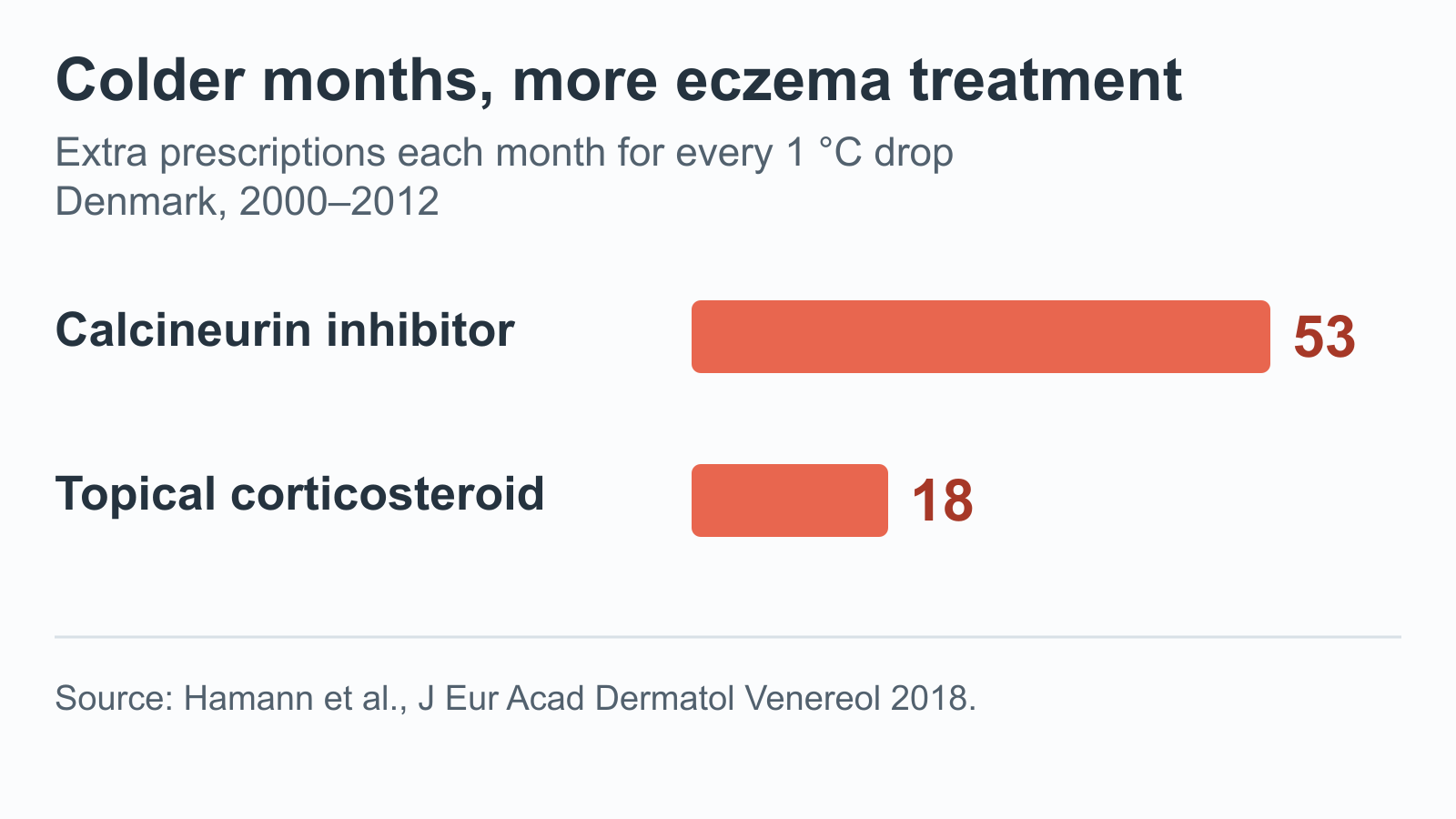
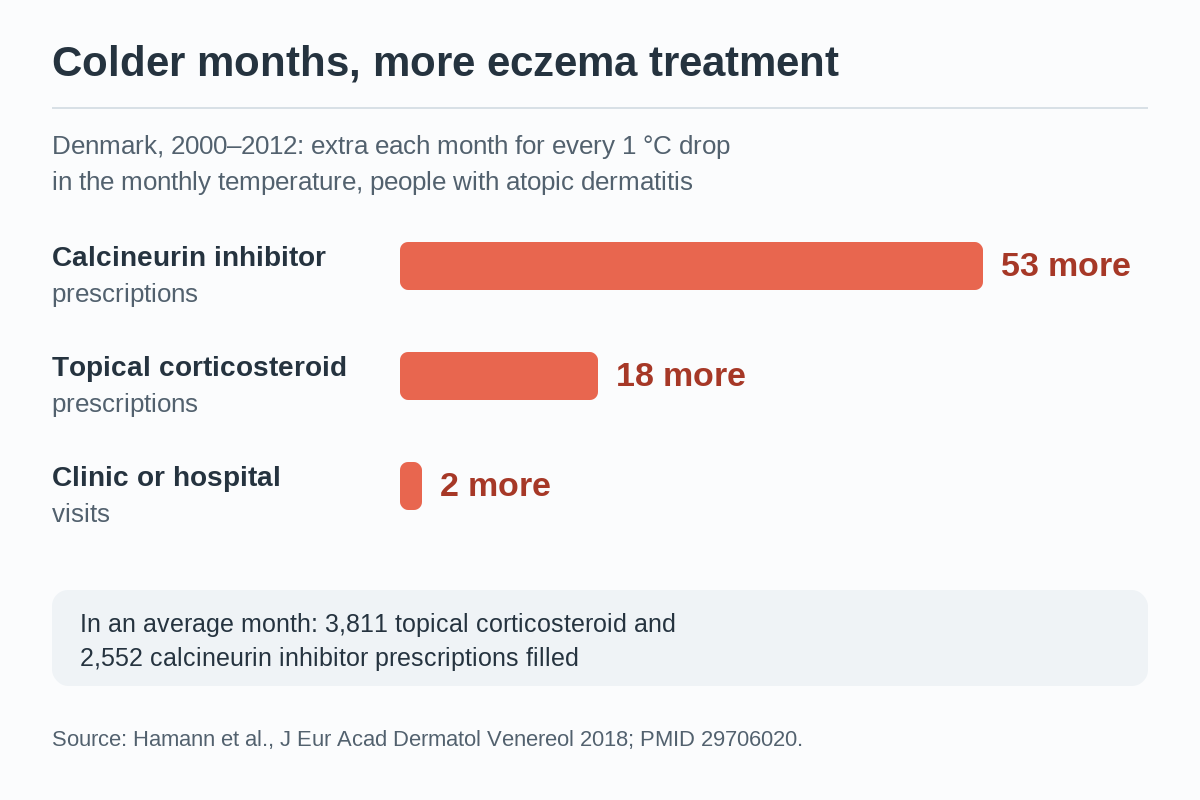
People with atopic dermatitis name changes in temperature, humidity and sunlight among their triggers. A Danish registry study compared 13 years of monthly weather records, from 2000 to 2012, with how often people with atopic dermatitis needed care: use was highest in winter and spring, and temperature showed the strongest link. For every 1 °C drop in the monthly temperature, there were 2 more clinic or hospital visits, 18 more prescriptions for topical corticosteroids (steroids applied to the skin) and 53 more for calcineurin inhibitors, the non-steroid creams and ointments used for eczema. The weather measures moved together, and the study could not say for certain that the cold itself caused the rise.[1]
Other things that can make atopic eczema worse include soap, washing detergent, some fabrics, pets, pollen and house-dust mites, heat or changes in temperature, skin infections, stress and hormonal changes (NHS).
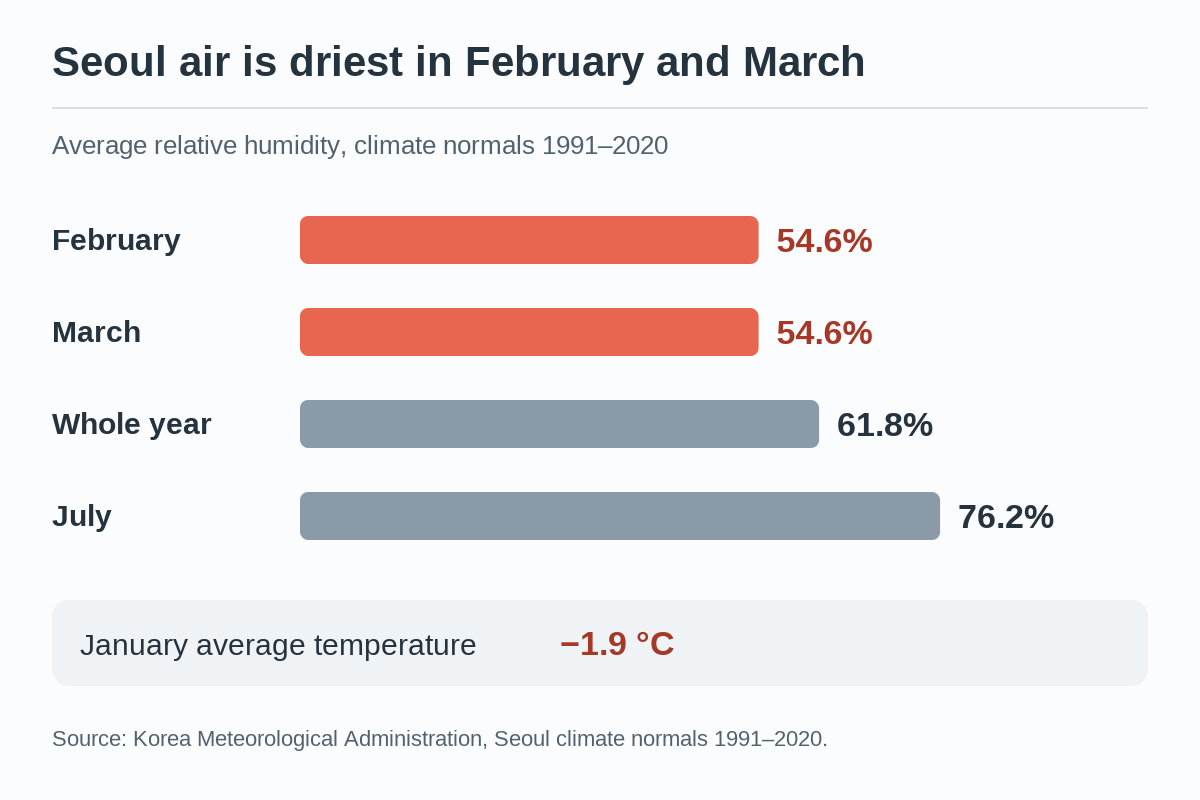
In Seoul the air is driest at the end of winter. Average relative humidity is 61.8% over the year, falls to 54.6% in February and March and peaks at 76.2% in July, and January averages −1.9 °C (Korea Meteorological Administration, Seoul climate normals 1991–2020, checked 1 November 2026). Wind, indoor heating and hot showers on a winter trip are covered in the guide to cold-weather redness in Seoul.
Eczema, seborrhoeic dermatitis, contact dermatitis or rosacea?
Several rashes make the face red and dry. Where the patches sit, what the surface looks like and what sets them off help to tell them apart.
| Condition | Where on the face | What it looks and feels like | A clue |
|---|---|---|---|
| Atopic eczema | Around the eyes in adults; cheeks, forehead and scalp in babies | Itchy, dry, scaly or thickened patches; red on light skin, grey, purple or darker on darker skin | Comes in flare-ups; more likely with a family history of eczema, asthma or hay fever |
| Seborrhoeic dermatitis | Areas rich in oil glands | Matching patches on both sides with blurred edges, yellow oily scales and fine flaking | On darker skin, lighter and slightly scaly patches may be the main sign |
| Contact dermatitis | Anywhere, most often the hands and face | Itchy, blistered, dry and cracked skin; red on lighter skin, dark brown, purple or grey on darker skin | Starts after contact with a particular substance and usually improves or clears once it is avoided |
| Rosacea | Nose, cheeks, forehead and chin | Early on, redness that comes and goes for a few minutes at a time; later the cheeks, nose and forehead may stay red; burning or stinging with water or skincare | Flushing that can make the face feel warm, hot or painful |
Sources for the table: the NHS pages on atopic eczema, contact dermatitis and rosacea (checked 1 November 2026), the American Academy of Dermatology, and a 2025 review of seborrhoeic dermatitis.[3]
Rosacea and eczema can look similar. Rosacea centres on the middle of the face, with redness that comes and goes at first and can become constant, while eczema is itchy, dry patches, often around the eyes in adults. The other causes of a red face, from flushing to visible vessels, are compared in what causes facial redness, and a rash of small bumps around the mouth, nose or eyes is covered under perioral dermatitis.
Caring for eczema on the face
- Use an emollient. Moisturising creams, lotions and ointments are one of the two main treatments; a pharmacist can help choose one.
- Swap the soap. Wash with an emollient instead of soap, and avoid washing detergent, fabrics or pets that make it worse.
- Keep cool. Being hot can make eczema itchier.
- Rub, do not scratch. If it itches, gently rub the area with a finger instead.
- Skip aqueous cream. It can irritate the skin and make eczema worse.
These steps follow the NHS advice, which also says not to change your diet unless a doctor tells you to. A pharmacist can suggest treatment for small areas that are dry and slightly itchy; for anything more, see a doctor. The main treatments are emollients and steroid creams, lotions or gels, and a doctor can add other treatments or refer you to a dermatologist (NHS).
Use a steroid cream on the face only as your prescriber advises: steroids applied to the face are also the trigger most often linked to a bumpy rash around the mouth and nose. For head and neck eczema that persists despite treatment, the 2026 review discusses newer targeted medicines, though direct comparisons between them are still limited.[2] If dry, red patches come back every autumn and winter, a dermatologist can help with telling seasonal dryness from dermatitis.
When to get urgent help
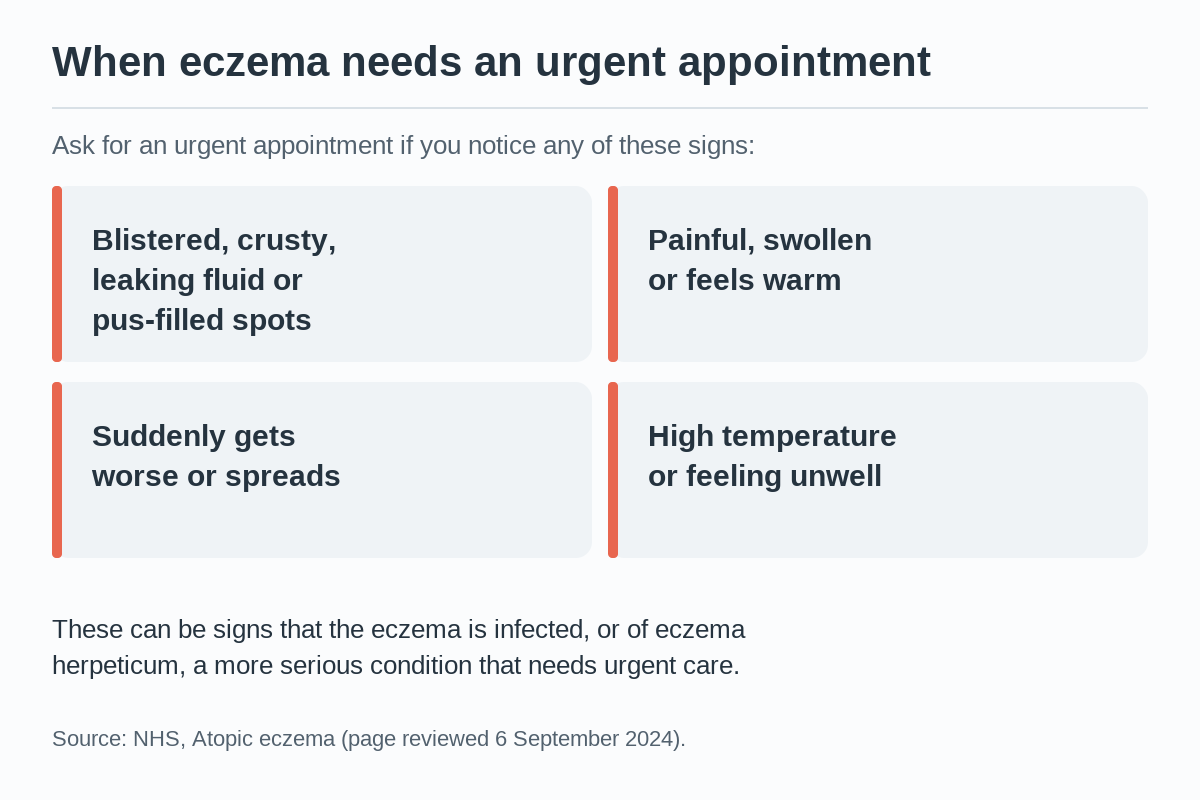
Ask for an urgent appointment if the eczema is blistered, crusty, leaking fluid or has pus-filled spots; if it is painful, swollen or feels warm; if it suddenly gets worse or spreads; or if you have a high temperature or feel unwell. These can be signs that the eczema is infected or of a more serious condition called eczema herpeticum, and both need prompt treatment (NHS).
Yellow or golden crusts often point to a staph infection. Eczema herpeticum, caused by the herpes simplex virus, brings dome-shaped blisters and bumps with fever, tiredness and swollen glands, and in babies, children and anyone with a weakened immune system it needs care at once (American Academy of Dermatology).
Is eczema on the face contagious?
No. The NHS states that atopic eczema is not contagious, so you cannot catch or spread it; an infection on top of it still needs treatment.
Can adults get eczema on the face for the first time?
Yes. According to the American Academy of Dermatology, atopic dermatitis usually begins early in life but can also start in adulthood, and adults are more likely than children to have it around the eyes.
What does eczema around the eyes look like?
In adults it often shows as thickened skin that is darker than the skin around it. Creases under the lower eyelids, called Dennie-Morgan folds, are another sign the American Academy of Dermatology describes; they also develop in people who have asthma or hay fever.
Does eczema on the face go away?
According to the NHS it cannot be cured, but symptoms tend to improve with age and treatment helps to manage flare-ups.
Is facial eczema worse in winter?
Colder months are linked with more eczema care: in Denmark, each 1 °C fall in the monthly temperature came with more visits and prescriptions. In Seoul the air is also at its driest in February and March.[1]
References (3)
Bibliographic records retrieved from PubMed (U.S. National Library of Medicine).
- Hamann CR, Andersen YMF, Engebretsen KA, et al. The effects of season and weather on healthcare utilization among patients with atopic dermatitis. J Eur Acad Dermatol Venereol. 2018;32(10):1745-1753. PubMed: 29706020
- LeFevre NM, Braudis K, Feigenbaum LS. Seborrheic Dermatitis: Diagnosis and Treatment. Am Fam Physician. 2025;112(2):166-173. PubMed: 40834373