Perioral dermatitis: a bumpy red rash around the mouth, nose and eyes
In short
Perioral dermatitis is a rash of small bumps around the mouth, beside the nostrils or around the eyes. On light skin the bumps look red and acne-like; on darker skin they are often skin-coloured. The skin around them tends to be dry and flaky, and it may itch or burn. Steroids are the trigger most often linked to it, whether rubbed on as a cream or taken in through a nasal spray or inhaler.
Written by Seoul Facial Redness editors. Published · Updated
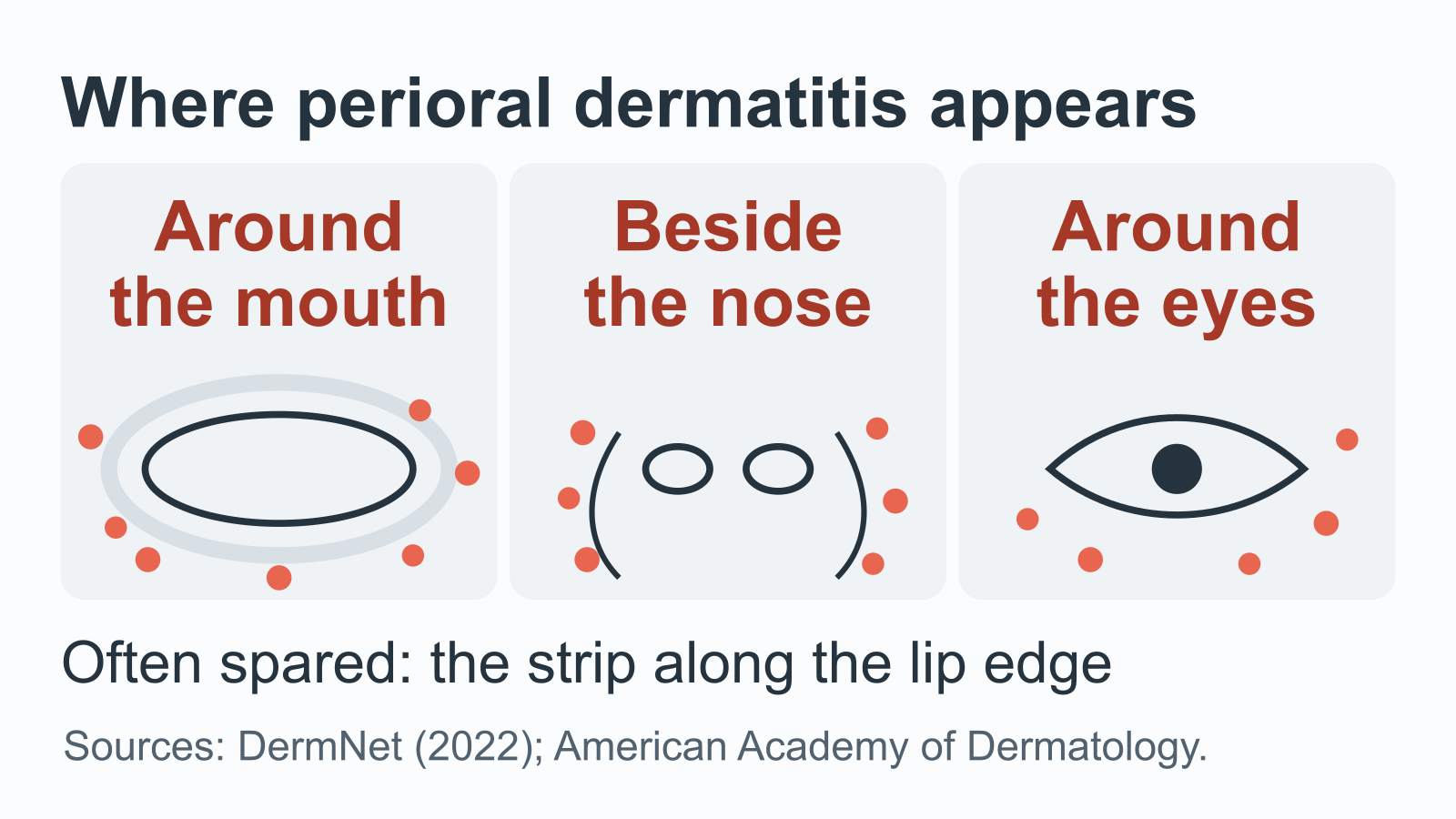
It is easy to mistake for acne or a reaction to a new product. Dermatologists also call it periorificial dermatitis, because it gathers around the openings of the face: the mouth, the nostrils and the eyes.
What does perioral dermatitis look like?
It appears as clusters of small bumps, usually under 2 mm each, that can be red or skin-coloured and can include tiny blisters or pus spots. They sit on a red base with a sharp edge, and the skin around them is often dry. The surface can be scaly and flaky, and the rash can burn, feel tight or itch; pain is rare (DermNet: Periorificial dermatitis, checked 2026-10-24).
On light skin the rash often looks like small red acne-like breakouts, and on skin of colour the bumps are often skin-coloured (American Academy of Dermatology: Perioral dermatitis, checked 2026-10-24). One feature helps to tell it apart: the narrow strip of skin right along the edge of the lips often stays clear.
Can it appear around the eyes and nose?
Yes. Around the mouth is the classic site, but the same rash can sit beside the nostrils and in the folds that run down from the nose, or around the eyes. Doctors then speak of perinasal or periocular dermatitis, and periorificial dermatitis covers them all. In more severe cases it can spread to the chin, cheeks, eyelids and forehead.
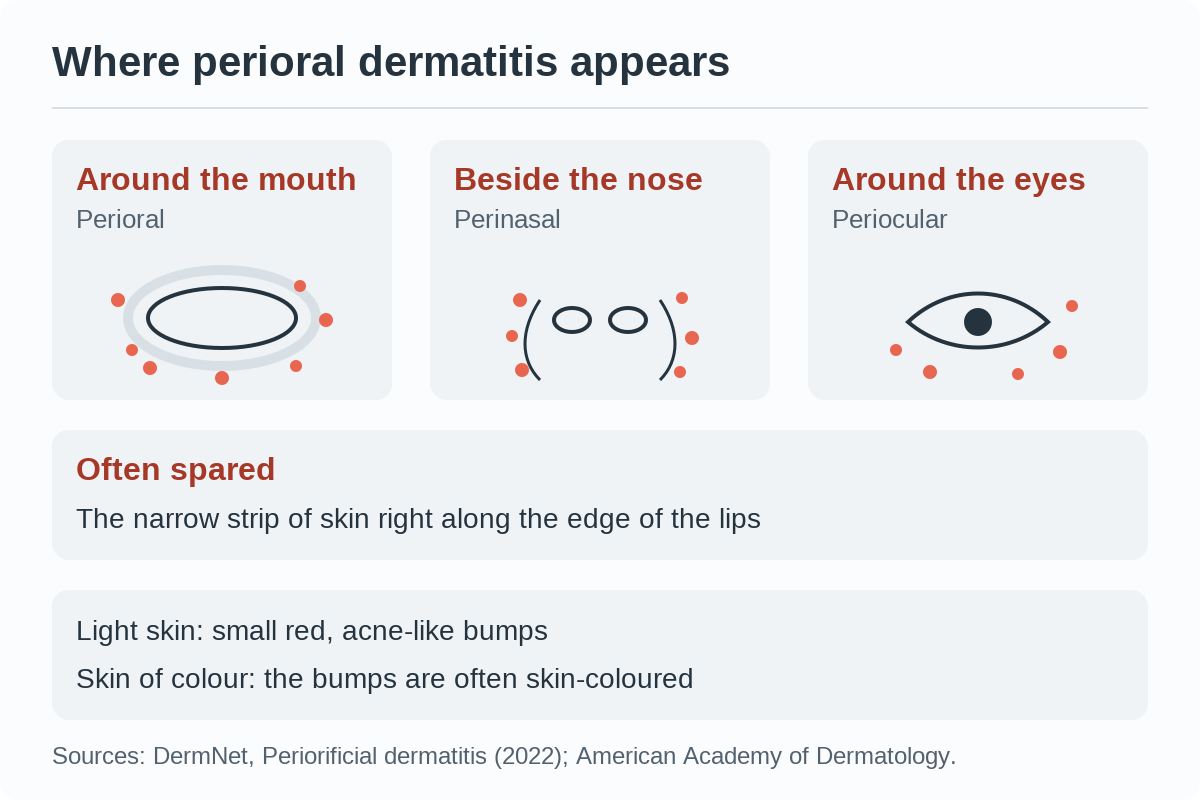
A bumpy, flaky rash around the eyes is easy to blame on an eye cream or make-up, and cosmetics can be part of the story. Check the nose and mouth as well: the rash can appear at more than one opening, such as the mouth and nose, or the nose and eyes.
Who gets perioral dermatitis?
It is most common in women aged about 20 to 45, and slightly more common in lighter-skinned women, but it is also seen in young children. In children, steroids are a well-established trigger, and most cases follow some exposure to them.[2]
What triggers perioral dermatitis?
The exact cause is still not understood. A 2025 review describes it as a chronic facial dermatitis of small bumps and pustules, and examines triggers, a weakened skin barrier, inflammation and the skin’s microbes as parts of the explanation.[1] The risk factors DermNet lists are practical ones:
- Steroids by any route: creams, nasal sprays and inhalers. Exposure can be accidental, as with a nasal spray, or intended.
- Cosmetics, and heavy, occlusive moisturisers such as paraffin- or petroleum-based products.
- Sunscreen, particularly mineral (physical) sunscreens in children.
- Irritants and allergens such as toothpaste and dental fillings.
- Hormonal changes: the contraceptive pill, pregnancy and the days before a period.
- UV light, heat and wind, which seem to make it worse.
Can a steroid nasal spray or inhaler cause it?
The two are linked. A 2026 study of US health records matched children with allergic rhinitis or asthma who used a steroid nasal spray or inhaler with similar children who used no nasal or inhaled product. New perioral dermatitis was recorded in 0.026% of the steroid users within six months, against 0.008% of the comparison group, and in 0.063% against 0.028% within a year. Non-steroid nasal and inhaled products showed no significant link.[2]
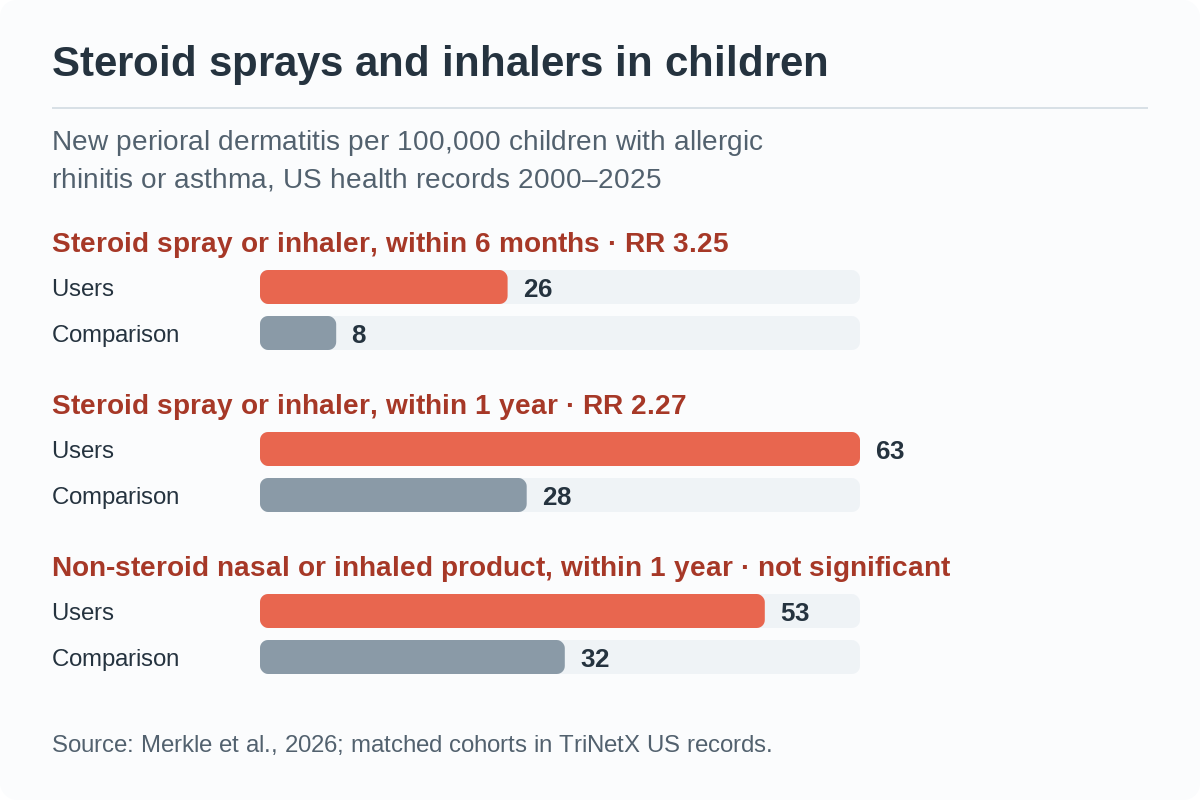
In absolute terms that is about 26 against 8 children in every 100,000 at six months. The authors suggest rinsing or wiping a child’s face after a nasal or inhaled steroid when the treatment cannot be stopped. DermNet’s advice is to keep taking nasal, inhaled and oral steroids that are medically necessary, accepting that the rash may take longer to settle, so raise the rash with the doctor who prescribes an inhaler rather than stopping it.
What should I do about a steroid cream?
The American Academy of Dermatology’s advice depends on where the cream came from:
- A hydrocortisone cream you started without your doctor’s knowledge: stop using it.
- A prescribed steroid: ask the doctor who prescribed it whether you can stop, and, if you need to keep using one, whether another medicine could replace it.
- The rash can worsen after stopping. Going back to the cream brings only temporary relief, and the rash can flare again each time it is stopped.
Stopping a potent steroid abruptly can bring a severe rebound flare, so DermNet advises weaning strong steroids slowly over weeks, stepping down to a weaker one before stopping. Steroid creams used on the face for a long time can also cause a rosacea-like redness of their own: in a series of 75 people with steroid dermatitis resembling rosacea, redness and heat, fine vessels and a rebound eruption of bumps were the main findings.[3] The guide to the causes of facial redness sets that pattern beside the other common ones.
How is perioral dermatitis treated?
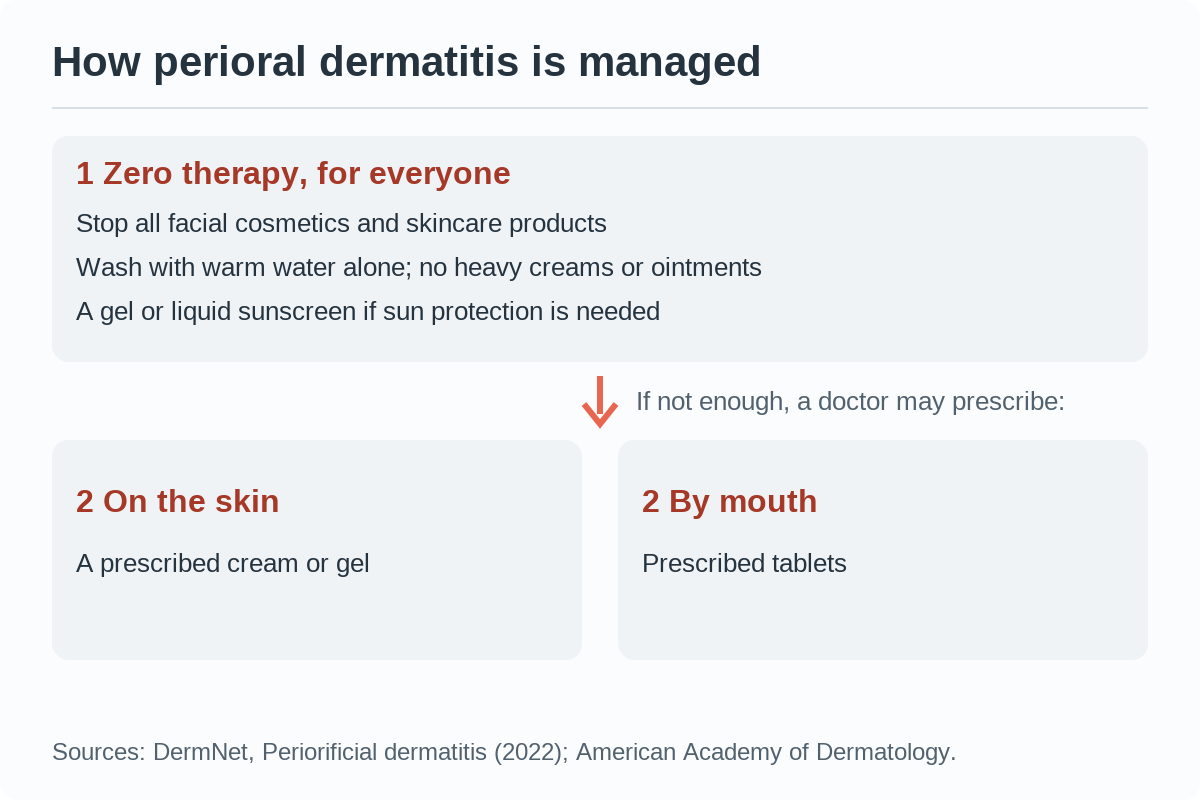
Treatment starts by taking things away. DermNet calls this zero therapy and recommends it for everyone with the rash:
- Stop all facial cosmetics and skincare products, including sunscreen and moisturiser.
- Wash with warm water alone until the rash clears, then move to a non-soap cleanser.
- If the skin feels dry, use a bland moisturiser without preservatives or additives, and avoid occlusive creams and ointments.
- If you need sun protection, use a gel or liquid sunscreen.
Zero therapy alone may clear a mild rash. When it is not enough, a dermatologist can prescribe metronidazole, erythromycin or pimecrolimus to apply to the skin, or an antibiotic from the tetracycline group to take by mouth, with erythromycin as the first choice in pregnancy and for children under eight. A course usually runs four to eight weeks, and the rash can return if treatment stops too early. Treatments applied to the skin are often hard to tolerate on sensitive facial skin, so tell your dermatologist if one is. The American Academy of Dermatology describes gradual improvement: clearing completely may take a few weeks or a few months.
Once the rash has cleared, the sensitive skin guide covers a gentle routine for reactive skin.
Is it perioral dermatitis, rosacea or acne?
| Look-alike | What sets it apart |
|---|---|
| Rosacea | Often older patients, a different spread across the face, and thickened nose skin (rhinophyma), which perioral dermatitis does not cause |
| Acne | Blackheads and whiteheads, nodules and cysts, which are not typical of perioral dermatitis |
| Seborrhoeic dermatitis | Involves the hairline, the scalp and the centre of the chest |
| Contact dermatitis | Follows an allergen or irritant, and the itch is often more intense |
Rosacea is diagnosed from persistent redness in the centre of the face that intensifies from time to time, or from thickened skin, and is treated according to its type.[4] Perioral dermatitis gathers around the openings of the face instead, though rosacea is a common co-diagnosis.[2]
Doctors usually diagnose perioral dermatitis by looking at it. Swabs or skin scrapings can rule out a bacterial or fungal infection, patch tests can check for a contact allergy, and a small biopsy is kept for cases that remain uncertain.
When should I see a dermatologist?
- The rash is not clearing after you have stopped steroid creams and heavy products.
- You use a prescribed steroid cream, nasal spray or inhaler and are unsure what to change.
- The bumps are spreading to the cheeks, eyelids or forehead.
- Larger red-brown bumps, or persistent yellowish ones in a child: these are the lupoid and granulomatous forms, and the lupoid form can scar.
- You are pregnant, which changes the choice of antibiotic.
Bring every product you put on your face, including any cream bought at a pharmacy abroad, and photos of the rash on a bad day.
What does early perioral dermatitis look like?
Small clusters of tiny bumps, usually under 2 mm, around the mouth or beside the nostrils, often on dry, flaky skin, and the rash can burn or feel tight. A clear strip along the lip line is a common clue, and on darker skin the bumps are often skin-coloured rather than red.
Is perioral dermatitis contagious?
No. Wherever it appears, you cannot catch it from someone else.
How long does perioral dermatitis take to clear?
It clears slowly. The American Academy of Dermatology says it may take a few weeks or a few months to clear completely, and DermNet gives a usual treatment course of four to eight weeks. Without treatment it can run on for months or years.
Should I keep moisturising perioral dermatitis?
Not with heavy creams or ointments, which can make it worse. During zero therapy, wash with warm water and, if the skin is dry, use a bland moisturiser without preservatives or additives.
Can perioral dermatitis come back?
Yes. It can return when antibiotics are stopped or later on, and the same treatment can be used again.
References (4)
Bibliographic records retrieved from PubMed (U.S. National Library of Medicine).
- Acevedo-Fontanez LA, Sánchez-Feliciano A, Ershadi S, et al. Periorificial dermatitis: Pathophysiology, diagnosis, and management. J Am Acad Dermatol. 2025;94(5):1483-1492. PubMed: 41197738
- Merkle T, Curley C, Wambold D, Iginla B, Ilyas EN. Association of Nasal and Inhalant Corticosteroids With Pediatric Perioral Dermatitis: A TriNetX Retrospective Cohort Study. Pediatr Dermatol. 2026;43(5):1158-1162. PubMed: 42107964
- Hameed AF. Steroid dermatitis resembling rosacea: a clinical evaluation of 75 patients. ISRN Dermatol. 2013;2013:491376. PubMed: 23691345
- Tan J, Almeida LM, Bewley A, et al. Updating the diagnosis, classification and assessment of rosacea: recommendations from the global ROSacea COnsensus (ROSCO) panel. Br J Dermatol. 2017;176(2):431-438. PubMed: 27718519