Broken capillaries on the face
In short
Broken capillaries are not actually broken. They are small blood vessels that have widened and stay visible, usually on the nose and cheeks. Make-up hides them, and prescription creams for rosacea can calm the redness around them for a few hours, but vascular lasers and intense pulsed light (IPL) are the treatments that make them fade.
Written by the Seoul Facial Redness editorial team and medically reviewed by a Korean Board-Certified Dermatologist (AAD International Fellow · ASLMS member). Last reviewed: .

What are broken capillaries?
The medical name is telangiectasia: fine red or purple lines, often branching, that sit just under the skin surface. They are a common part of rosacea, where the NHS describes them as tiny broken blood vessels that do not go away (NHS: Rosacea, checked 2026-10-18). They also appear on their own, especially on sun-exposed skin.
Why do broken capillaries appear on the face?
- Rosacea, where vessels stay dilated after years of flushing and redness.
- Long-term sun exposure on the cheeks and nose.
- Steroid creams used on the face for months: fine vessels were a main finding in a series of 75 people with steroid-induced redness.[1]
Heat from saunas or very hot showers can trigger flushing and make existing vessels more noticeable. An isolated visible vessel is often harmless, but a new vessel over a spot that is growing, bleeding or not healing needs examination. If vessels come with redness that flares, bumps or stinging, read flushing or persistent redness first, because treating the vessels does not treat what made them.
Which lasers treat broken capillaries?
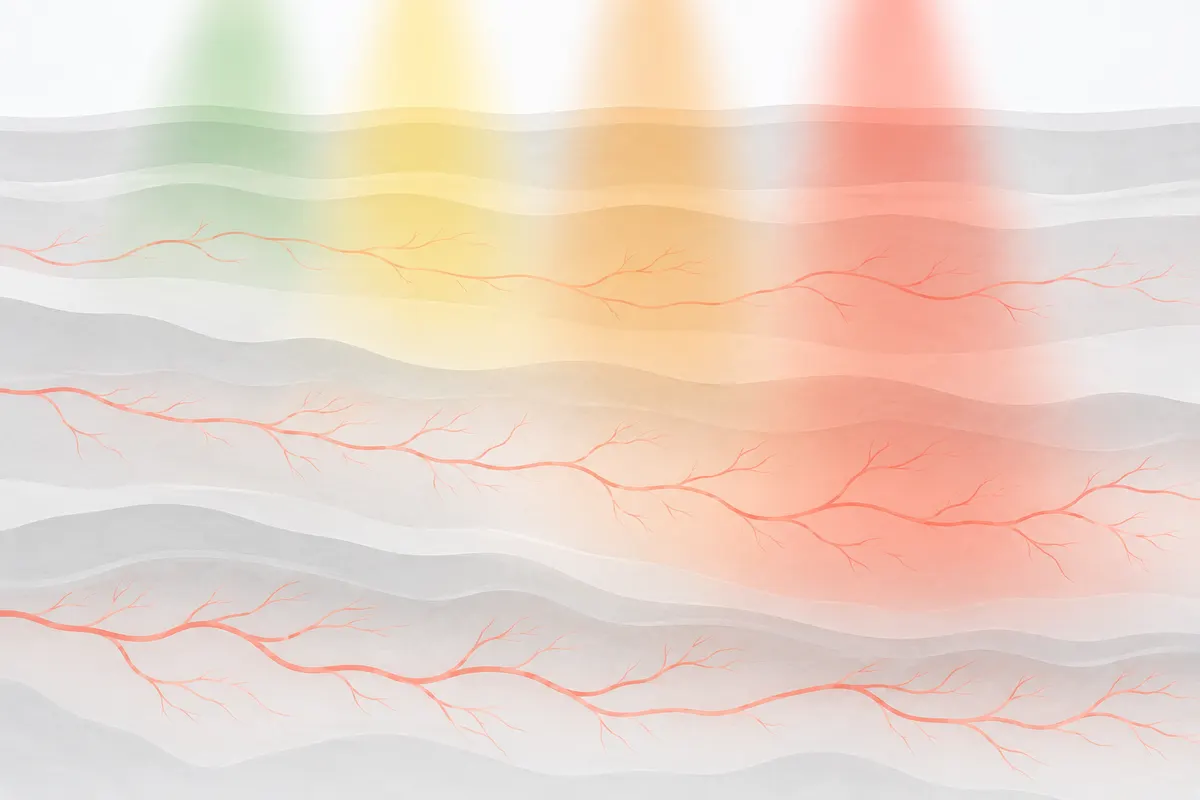
Vascular lasers send light that the red pigment in blood absorbs. The heat closes the vessel, and the body clears it over the following weeks. Four types of device are in common use.
| Device type | Wavelength | Suited to | What to expect after |
|---|---|---|---|
| Pulsed dye laser (PDL) | 585–595 nm | Diffuse redness and fine vessels | Swelling for a day or more is common; bruise-like purple marks at higher settings |
| KTP laser | 532 nm | Distinct fine red lines | In one split-face trial, more swelling and redness than PDL |
| Intense pulsed light (IPL) | Filtered broad band, for example from 560 nm | Background redness with fine vessels; also brown spots | Results similar to non-bruising PDL in one trial |
| Long-pulsed Nd:YAG | 1064 nm | Thicker, deeper or bluish vessels | Comparable to PDL for nose vessels in a Korean study |
How well do vascular lasers work on facial vessels?
In a split-face trial of 15 patients, the KTP laser cleared an average of 62% of vessels after one session and 85% three weeks after the third, compared with 49% and 75% for the pulsed dye laser. The KTP side caused more swelling and redness: 58% of people with redness lasting a day or longer said it was worse on the KTP side, against 8% on the PDL side.[2]
In a randomised trial of 29 people with redness-type rosacea, three monthly sessions of non-bruising PDL and IPL reduced redness and visible vessels by a similar amount.[3] A Korean split-nose study found long-pulsed Nd:YAG and PDL gave similar overall results after three sessions four weeks apart; Nd:YAG did better on thick, dilated vessels, while PDL did better on redness with fine vessels.[4]
These studies are small, and a systematic review rated the overall certainty of laser and IPL evidence as low to moderate.[5] In practice the choice depends on vessel size and colour, skin type and the devices a clinic owns.
How many sessions will I need?
The trials above used three sessions, three to four weeks apart. Fine single vessels may need fewer; widespread redness with many vessels often needs a full course. The tendency that produced the vessels, such as rosacea or sun exposure, does not disappear with them, so ask how follow-up is planned.
Can I treat broken capillaries on a short trip to Seoul?
One session fits into most trips if you book it early, leaving a few days for swelling to settle before photos or a flight. A full course means returning every three to four weeks, or starting in Seoul and continuing at home. Ask which device the clinic will use and why: a clinic without a pulsed dye laser may suggest IPL or Nd:YAG instead, and that can be a reasonable choice for your vessel type. For timelines by device, see how long redness lasts after laser.
What does vascular laser treatment cost in Seoul?
Prices depend on the device, the area and whether you book one session or a course. For reference, Delight Dermatology Clinic in Seoul lists GentleMax Genesis Toning, a 1064 nm Nd:YAG treatment it uses for facial redness, at KRW 220,000–1,450,000, from a single session to a package. Prices checked 2026-10-18; confirm at consultation.
Do broken capillaries go away on their own?
Usually not. Visible facial vessels tend to stay unless they are treated, although they can look less obvious when flushing is under control.
Can skincare remove broken capillaries?
No cream closes a visible vessel. A green-tinted primer or concealer hides redness, and prescription creams for rosacea redness calm background colour for a few hours, but the vessels themselves respond to laser or IPL.
Will treated capillaries come back?
Treated vessels can stay faded for a long time, but new ones can appear while the cause continues. Sun protection and managing flushing help keep repeat sessions to a minimum.
References
Bibliographic records retrieved from PubMed (U.S. National Library of Medicine).
- Hameed AF. Steroid dermatitis resembling rosacea: a clinical evaluation of 75 patients. ISRN Dermatol. 2013;2013:491376. PubMed: 23691345
- Uebelhoer NS, Bogle MA, Stewart B, Arndt KA, Dover JS. A split-face comparison study of pulsed 532-nm KTP laser and 595-nm pulsed dye laser in the treatment of facial telangiectasias and diffuse telangiectatic facial erythema. Dermatol Surg. 2007;33(4):441-8. PubMed: 17430378
- Neuhaus IM, Zane LT, Tope WD. Comparative efficacy of nonpurpuragenic pulsed dye laser and intense pulsed light for erythematotelangiectatic rosacea. Dermatol Surg. 2009;35(6):920-8. PubMed: 19397667
- Kwon WJ, Park BW, Cho EB, Park EJ, Kim KH, Kim KJ. Comparison of efficacy between long-pulsed Nd:YAG laser and pulsed dye laser to treat rosacea-associated nasal telangiectasia. J Cosmet Laser Ther. 2018;20(5):260-264. PubMed: 29388843
- van Zuuren EJ, Fedorowicz Z, Tan J, et al. Interventions for rosacea based on the phenotype approach: an updated systematic review including GRADE assessments. Br J Dermatol. 2019;181(1):65-79. PubMed: 30585305