Hives from the cold: how to recognise cold urticaria
In short
Cold urticaria is a form of hives: itchy, raised red welts on skin that has been cold, which usually appear as the skin warms up again, often on skin that clothing leaves bare, such as the face and hands. Each crop typically fades within one to two hours. A dermatologist can test for it with an ice cube, but a negative test does not rule it out.
Written by Seoul Facial Redness editors. Published · Updated
You come in from a windy walk along the Han River, and your cheeks or the backs of your hands rise into itchy welts. Welts like these after the cold may be cold urticaria.
What does cold urticaria look like?
Urticaria, or hives, is driven by mast cells in the skin and shows as welts, deeper swelling called angioedema, or both.[1] In cold urticaria the trigger is cold: symptoms start within 2–5 minutes of exposure and last 1–2 hours (DermNet: Cold urticaria, checked 2026-10-24). The skin signs to tell a dermatologist about are:
- Welts, sometimes itchy
- A burning feeling
- Swelling and discolouration on skin exposed to the cold
The welts tend to rise as the skin warms again, so they often show after you come indoors rather than while you are outside. Some people react only to cold water or a cool wind; others react to an air-conditioned building or the freezer aisle of a supermarket (American Academy of Dermatology: Cold urticaria, updated 2024-12-18, checked 2026-10-24).
Is it cold urticaria, dry winter skin or flushing?
| Pattern | What you see | Timing |
|---|---|---|
| Cold urticaria (hives) | Raised welts, often itchy or burning, on skin that was cold, sometimes with deeper swelling | Within minutes, as the skin warms; each crop lasts 1–2 hours |
| Dry winter skin | Dry, itchy skin that reacts more easily to irritants and rubbing | Through the cold, dry months |
| Flushing | Redness from a change in blood flow to the skin | Comes and goes |
Raised welts are the difference to look for. Low humidity and low temperature weaken the skin barrier, leaving skin dry, itchy and quicker to react to irritants,[4] and the guide to cold-weather redness in Seoul covers that kind of winter care. Flushing comes from a change in blood flow that many conditions can trigger,[5] and flushing or persistent redness explains how to tell its patterns apart.
When is cold urticaria an emergency?
Most people who get hives from the cold are otherwise healthy, but a reaction can spread beyond the skin. Get emergency help if, after cold air, a cold drink or a swim, you notice:
- Swelling of the lips or throat
- Shortness of breath, wheezing or difficulty breathing
- Feeling faint or light-headed, or a fast, irregular heartbeat
In Korea, call 119 for an ambulance. The service is free, and interpreters are available for callers who do not speak Korean (Seongbuk District Office, Seoul: Medical service, checked 2026-10-24).
That deeper swelling, angioedema, is most often seen around the eyes and lips (DermNet: Angioedema, checked 2026-10-24). Swimming in cold water is the most common cause of a severe cold urticaria reaction, and DermNet advises that swimming and surfing always be supervised. After a serious reaction, a dermatologist may recommend always carrying an emergency injection pen.
How the ice cube test works
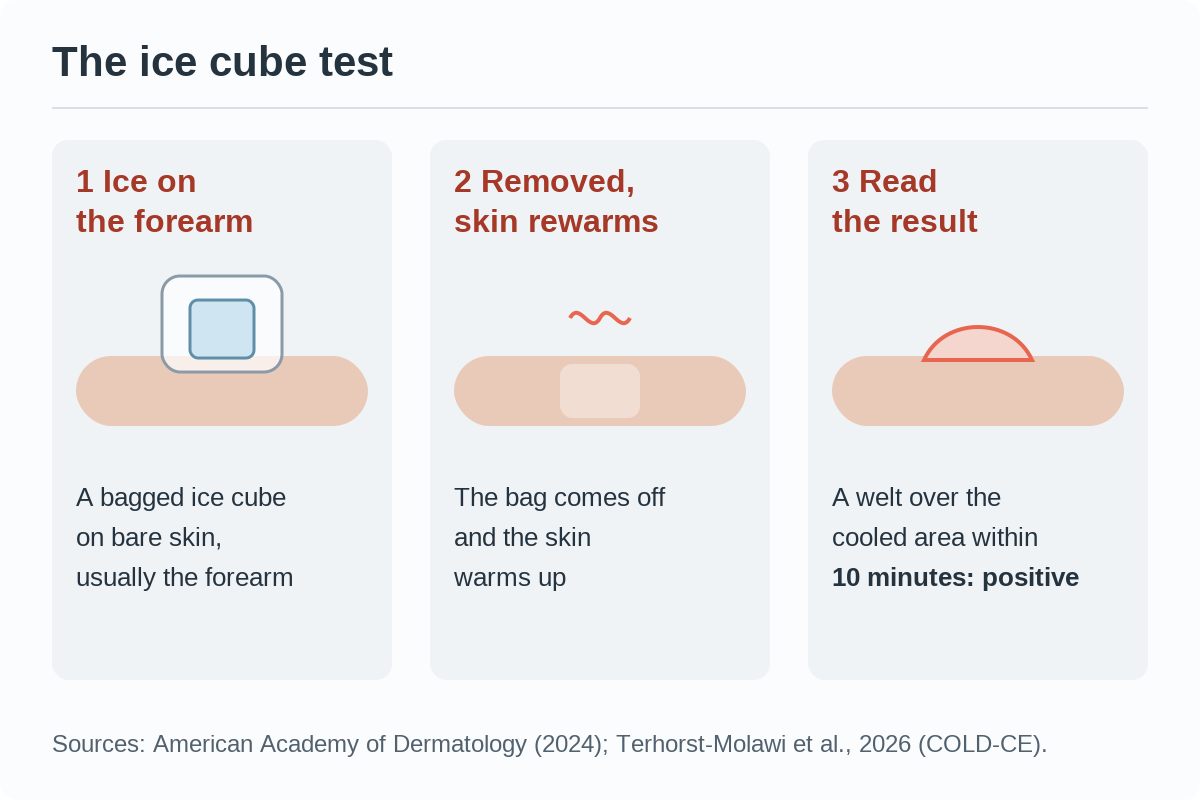
A dermatologist does the test in the clinic, alongside questions about your symptoms.
Step 1 of 5: Questions about the cold
The dermatologist asks what symptoms you get when you are exposed to cold.
Step 2 of 5: Ice on the forearm
An ice cube sealed in a plastic bag is placed on bare skin, usually the inner forearm.
Step 3 of 5: Removal and rewarming
The bag is taken off and the skin is left to warm up. In cold urticaria a welt usually rises as it warms.
Step 4 of 5: Reading the result
In the standard test, a welt over the cooled area within 10 minutes counts as positive.[2]
Step 5 of 5: Further checks
Blood counts and metabolic tests can look for an underlying condition.
Can the ice cube test be negative if I have cold urticaria?
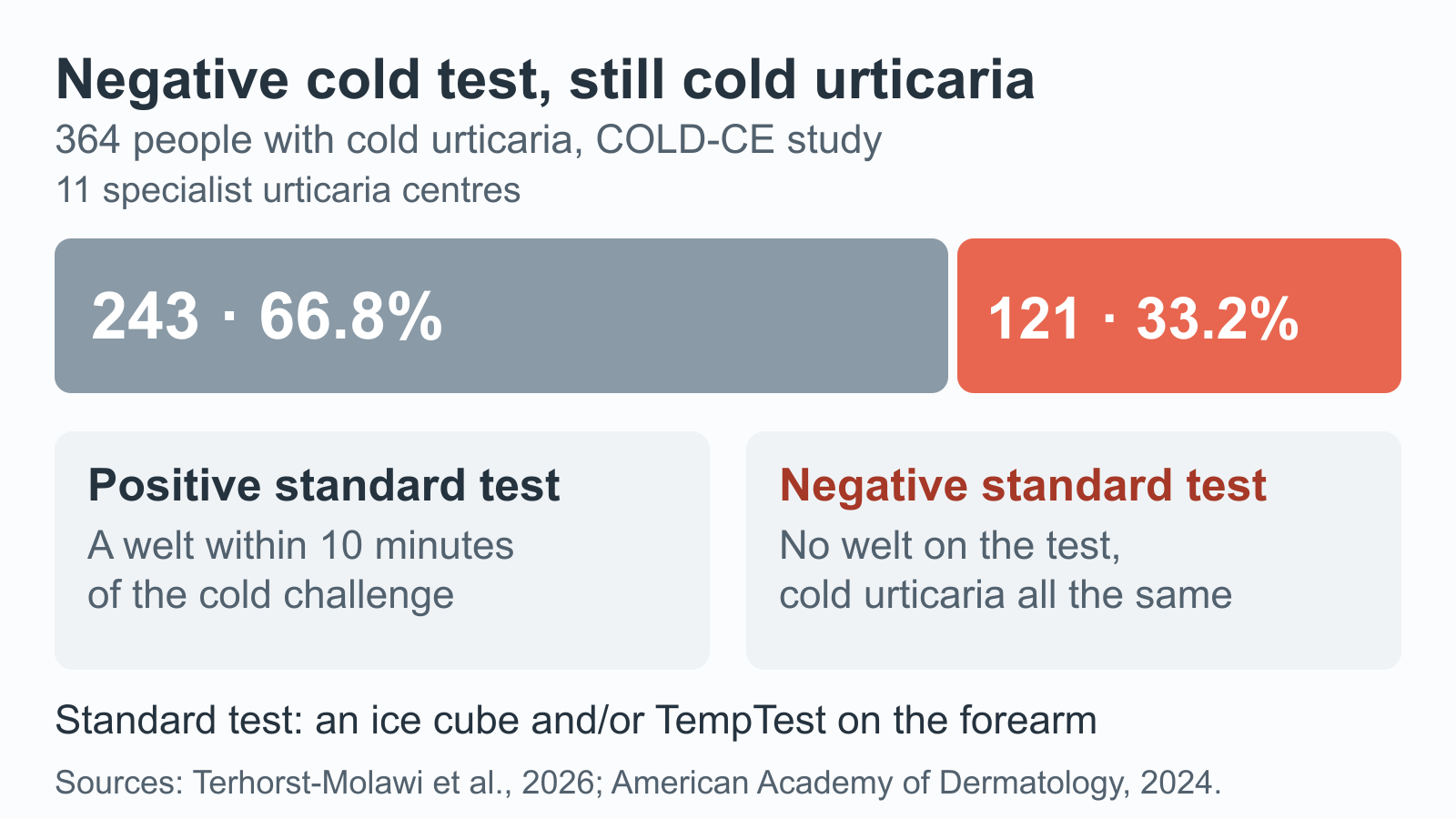
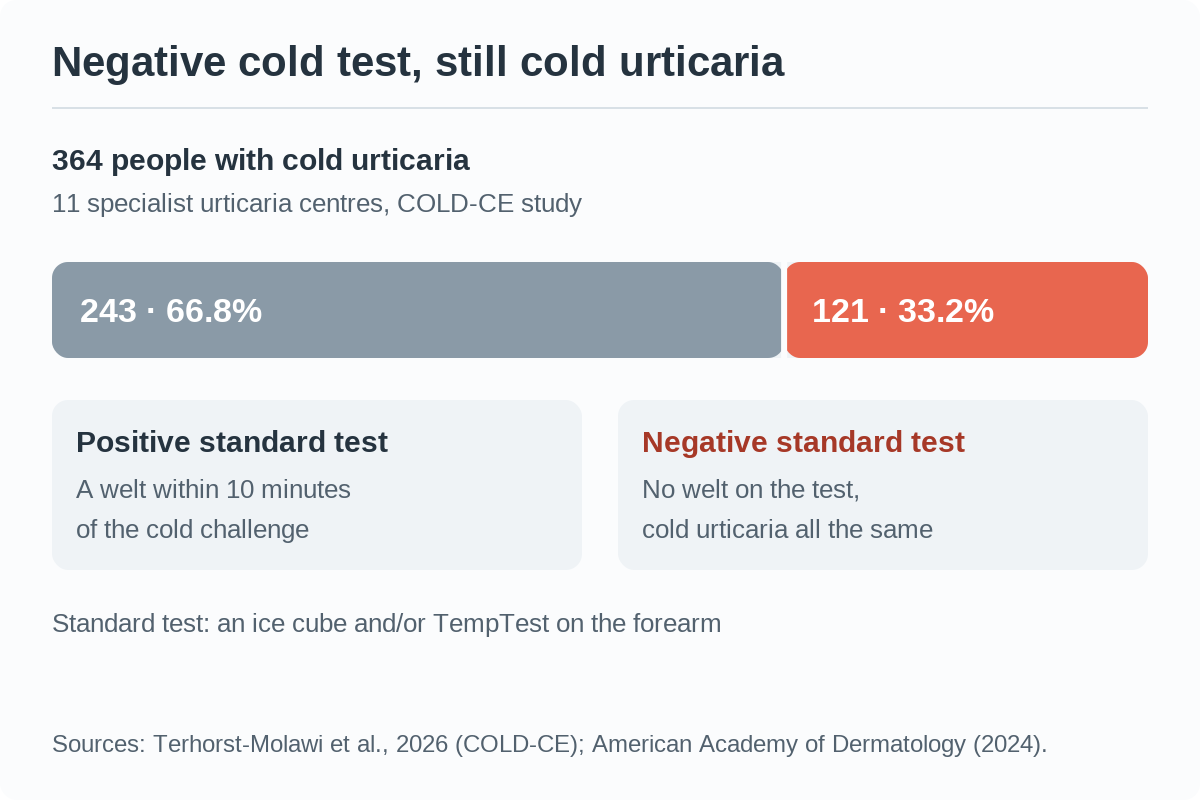
Yes. A person can have cold urticaria without a welt on the ice test, which is why the dermatologist also asks questions and examines the skin. In the COLD-CE study of 364 people with cold urticaria at 11 specialist centres, 121 (33.2%) had a negative standard cold stimulation test, done with an ice cube and/or TempTest. Compared with those who tested positive, they were younger, their symptoms had started earlier, and they more often had a family history of cold urticaria or chronic spontaneous urticaria alongside it.[2]
The test-positive group more often reported throat swelling, difficulty breathing and heart or circulation symptoms. Bring photos of the welts and a note of what set them off: when the test is negative, the diagnosis rests on that history and on the examination.
Living with cold urticaria in a Seoul winter
The Korea Meteorological Administration puts the normal range of the average January temperature in Seoul, Incheon and Gyeonggi at −3.2 to −1.8 °C, based on 1991–2020 records (KMA three-month outlook, 23 October 2026, checked 2026-10-24). Avoiding what sets off the welts comes first:
- Cover your cheeks and hands outdoors, especially in the wind.
- If iced drinks or cold food make your lips or throat swell, avoid all cold food and drinks.
- If cold water brings out welts, stay out of it, from winter swims to the cold pool at a bathhouse.
For many people, avoiding the trigger is enough. When it is not, an antihistamine taken by mouth helps many patients, and if it does not prevent the welts, a dermatologist may prescribe a stronger medicine or add another. If welts keep returning during a trip, photograph them and note what set them off, then show both at a same-day dermatology visit in Seoul or to your own doctor at home.
Tell the clinic before laser or cooling treatments
Some laser hair removal uses cold to ease discomfort. In a 2026 report, two teenagers developed welts in the area cooled for pain relief during laser hair removal; their later sessions used a topical anaesthetic instead, and treatment continued.[3] If cold has ever given you welts, say so before any treatment that cools the skin, so the clinic can plan another way to keep you comfortable. Before surgery, DermNet advises telling the anaesthetist in advance. The guide to redness after procedures covers the redness that normally follows laser treatment.
Can you get cold urticaria only on your face?
Welts appear on the skin that gets cold, so the face and hands are common places in winter, especially skin that clothing did not cover. Some people react only to a cool wind or cold water.
Who gets cold urticaria?
It is uncommon, affecting about 0.05% of people. It is most often diagnosed in young and middle-aged adults and is about twice as common in women as in men.
Can something else cause cold urticaria?
Most cases have no known cause, but cold urticaria can follow an infection or occur with a blood disorder, which is why a dermatologist may order blood tests.
Does cold urticaria go away?
It can. The American Academy of Dermatology says some people see it go away within weeks or months and about half within five years. DermNet says it usually lasts for some years, with about 30% reporting resolution within 5 to 10 years. For some people it lasts for life.
References (5)
Bibliographic records retrieved from PubMed (U.S. National Library of Medicine).
- Zuberbier T, Abdul Latiff AH, Abuzakouk M, et al. The international EAACI/GA²LEN/EuroGuiDerm/APAAACI guideline for the definition, classification, diagnosis, and management of urticaria. Allergy. 2021;77(3):734-766. PubMed: 34536239
- Terhorst-Molawi D, Ahsan DM, Fomina D, et al. Cold Urticaria With Negative Standard Cold Stimulation Testing: Results From the COLD-CE Study. J Allergy Clin Immunol Pract. 2026;14(10):2397-2407.e4. PubMed: 42641985
- Jo S, Abrajano C, Chiu B. Development of cold urticaria after cryotherapy during laser epilation for pilonidal disease: a case report. Int J Surg Case Rep. 2026;138(8):3044-3047. PubMed: 42578112
- Engebretsen KA, Johansen JD, Kezic S, Linneberg A, Thyssen JP. The effect of environmental humidity and temperature on skin barrier function and dermatitis. J Eur Acad Dermatol Venereol. 2015;30(2):223-49. PubMed: 26449379
- Izikson L, English JC, Zirwas MJ. The flushing patient: differential diagnosis, workup, and treatment. J Am Acad Dermatol. 2006;55(2):193-208. PubMed: 16844500